License: CC0
Original Size: 9000 × 6000 pixels
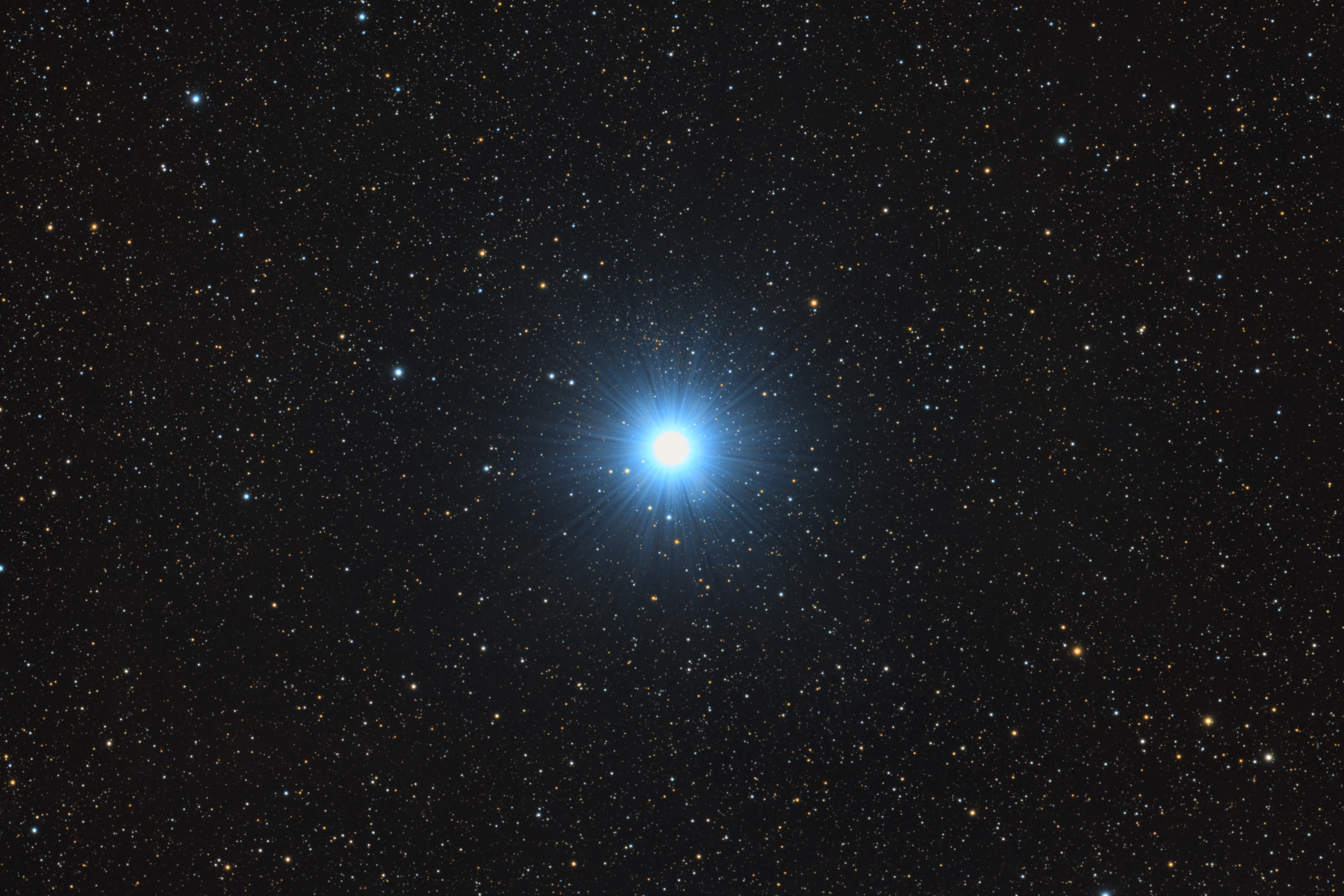
Description: Sirius is the brightest star in the night sky. It appears so bright because of both its luminosity (true brightness) and its proximity to us. It is one of the closest stars to us, at a distance of only 8.6 light-years. It is about twice as massive as our Sun, and about 25 times more luminous. Sirius is a main-sequence dwarf star, so its luminosity is much lower than that of giant, extremely bright stars like Canopus, Betelgeuse, and Rigel. Those stars only appear fainter than Sirius in our sky because of how far away they are.
This image was a challenge to process. Because Sirius is so bright, the image started with a giant, 300-pixel-wide circle of blown-out highlights. PixInsight has a tool to recover typical blown-out star cores, but these are usually 10 times smaller. I had to carefully separate all of the stars except Sirius from the image and process them separately before recombining at the end. Multiscale Adaptive Stretch (MAS) works perfectly for stretching. I’m happy with this result!
Total integration: 1 hour 0 minutes 2021/01/10: 10 x 360 seconds ISO1600
Location: St. Luke’s Episcopal Church in Simeon, VA SQM: 20.38 mag/arcsec^2 (Bortle 4.5) Camera: Canon T3i (stock/unmodified) Average camera temperature: 70 F (21 C) Telescope: Explore Scientific ED80 f/6.0 Apochromatic Refractor (with ES field flattener) Mount: Orion Sirius EQ-G Guide scope: Svbony 50mm f/4.0 Guide Scope Guide camera: Orion StarShoot AutoGuider Capture software: N.I.N.A., ASTAP, PHD2
Processing software: PixInsight, GIMP